
Missed service departures
Vehicles must be ready before the first departure. Overnight maintenance capacity directly determines whether the timetable runs.
Mechanic profile
Explore mechanic profiles with experience in public transport fleets — bus chassis, diesel and alternative powertrains, air brakes, door systems and shift-based depot maintenance.
The employer challenge
Public transport operates to a published schedule. A bus unavailable at 05:00 is not a delayed repair — it is a cancelled service and a contractual penalty.
Vehicles must be ready before the first departure. Overnight maintenance capacity directly determines whether the timetable runs.
Public transport contracts typically specify fleet availability, making downtime a financial as well as operational problem.
The bulk of maintenance happens outside service hours, and staffing those shifts is persistently difficult.
Door mechanisms and wheelchair ramps fail frequently and take a bus out of passenger service immediately.
Depots often run several generations and powertrain types simultaneously, each with different procedures.
Braking, steering and door safety systems carry a duty of care that leaves no room for deferred repair.

Role overview
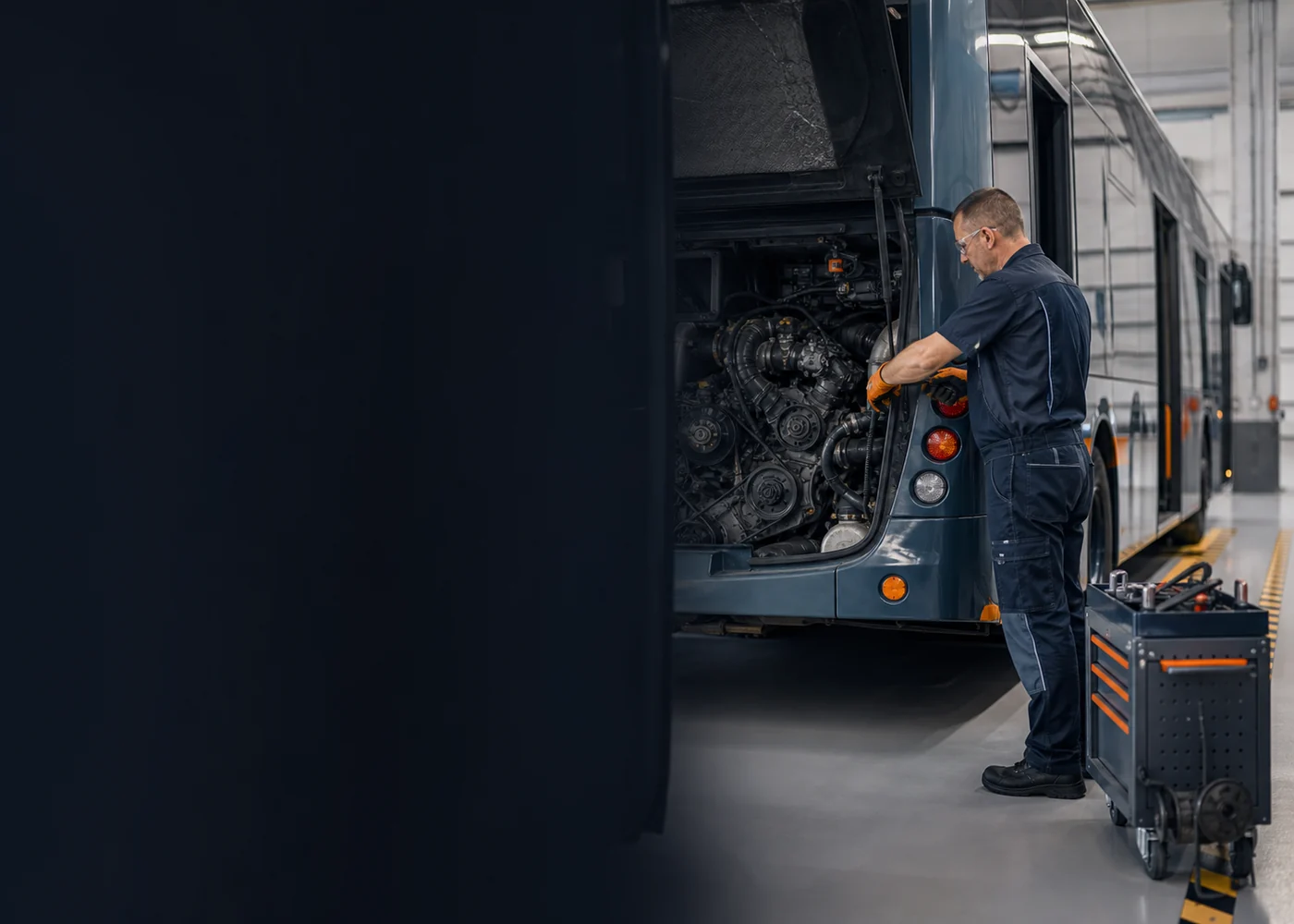
A bus mechanic maintains and repairs passenger transport vehicles within a depot or workshop environment. The role spans diesel and increasingly hybrid, CNG and electric powertrains, air braking systems, suspension, steering, door and access systems, heating and climate control, and the electrical systems supporting ticketing, lighting and passenger information.
The operating rhythm is distinctive. Work is concentrated in the overnight and early morning window when vehicles return to the depot, and it is governed by a daily availability target rather than customer appointments.
Passenger safety obligations shape the standard of work. Braking, steering, door interlocks and accessibility equipment are inspected to defined regimes, and documentation of that work carries regulatory weight.
Compared with a truck mechanic, the underlying chassis and braking technology are closely related, and mechanics move between the two relatively easily. The differences are door and access systems, passenger comfort equipment and depot shift patterns.
Compared with an automotive mechanic, the scale, braking technology and regulatory environment are entirely different, and the transition requires retraining.
Relevant systems and equipment
Profiles may include experience with:
What employers should verify
Balkan Mechanic does not certify candidates. Use this list as the basis for your own screening and interviews.

How recruitment continues
Pin down the specialization, systems and experience level you need.
Review mechanic profiles that match your vehicles and machines.
Describe the role, systems and shift requirements clearly.
Assess candidate information and verify qualifications.
Manage interviews and the rest of the workflow in one place.
Related mechanic profiles
Closely related commercial vehicle skills and systems.
View profileEngine specialists for powertrain-level work.
View profilePreventive maintenance and availability planning.
View profileFor fleets with extensive electronic systems.
View profileFor support vehicles within the same operation.
View profileFor operators running plant alongside passenger fleets.
View profileFAQ
Explore profiles, publish your vacancy and manage applications in one structured platform.