
Unplanned line stoppages
A failed bearing or drive halts an entire production line, and the cost per hour usually dwarfs the repair itself.
Mechanic profile
Explore mechanic profiles with experience in production machinery — bearings, gearboxes, conveyor systems, pumps, mechanical alignment, fault diagnosis and structured preventive maintenance.
The employer challenge
In a production environment, maintenance capability is measured in minutes of downtime. A line that stops unexpectedly costs output, labour and delivery commitments simultaneously.
A failed bearing or drive halts an entire production line, and the cost per hour usually dwarfs the repair itself.
Planned work is the first thing sacrificed when the team is stretched — which reliably increases unplanned failures.
With production waiting, the ability to isolate a fault quickly and correctly is worth far more than raw mechanical strength.
Incorrectly aligned couplings and drives destroy bearings and seals repeatedly until someone diagnoses the real cause.
Planned maintenance windows are fixed. Insufficient staffing turns a weekend shutdown into a Monday production loss.
Without records, recurring failures are never recognised as patterns and the same fault is repaired indefinitely.

Role overview
An industrial machinery mechanic maintains and repairs production equipment within manufacturing plants. The work covers mechanical assemblies — bearings, shafts, gearboxes, couplings, conveyors, pumps and drives — combining scheduled preventive maintenance with fault diagnosis and rapid repair when production stops.
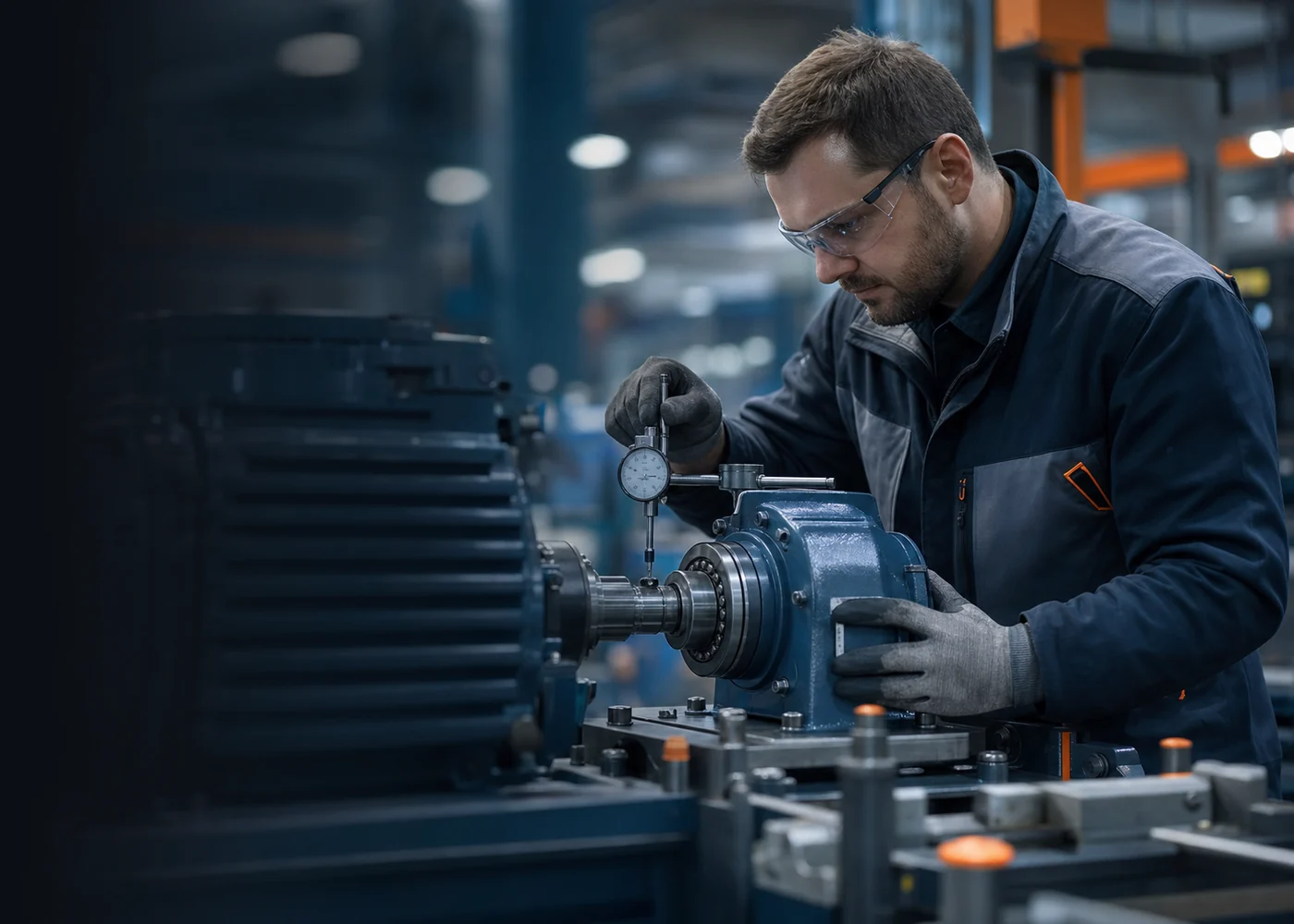
Precision defines this role more than force. Alignment tolerances, bearing fits, belt tension and lubrication regimes determine whether a machine runs for years or fails within months. The best candidates measure rather than estimate.
The work rhythm is shaped by production. Some tasks happen during planned shutdowns with a fixed window; others are emergency interventions with the line stopped and management watching. Both require composure and method.
Compared with a maintenance technician, the mechanic profile concentrates on mechanical assemblies, while the technician title often implies broader responsibility including electrical systems, instrumentation and control.
Compared with a heavy equipment mechanic, the environment is fixed rather than mobile, cleaner, and oriented toward precision and uptime rather than field repair and structural work.
Relevant systems and equipment
Profiles may include experience with:
What employers should verify
Balkan Mechanic does not certify candidates. Use this list as the basis for your own screening and interviews.
Relevant industries

How recruitment continues
Pin down the specialization, systems and experience level you need.
Review mechanic profiles that match your vehicles and machines.
Describe the role, systems and shift requirements clearly.
Assess candidate information and verify qualifications.
Manage interviews and the rest of the workflow in one place.
Related mechanic profiles
Mobile plant with comparable hydraulic systems.
View profileStationary diesel units and standby generation.
View profileProcessing and handling machinery.
View profileSite equipment with overlapping mechanical skills.
View profilePlanned maintenance discipline across asset groups.
View profileFor plants operating their own vehicle workshop.
View profileRelevant guides
FAQ
Explore profiles, publish your vacancy and manage applications in one structured platform.